
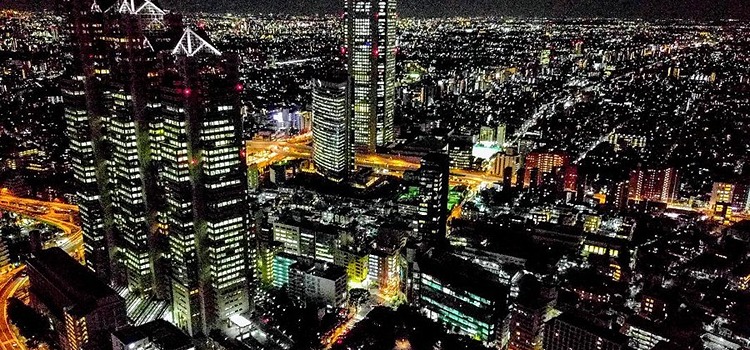
It is often said that an image can say more than a thousand words. A photograph shared a few weeks ago on Twitter by @arai_yusaku illustrates this idea particularly well. Taken at around 6:00 p.m. in Shibuya, one of Tokyo’s main business districts, the image shows two neighbouring skyscrapers at night — and a striking contrast between them.
In the building on the left, office lights are still brightly on across many floors. In the building on the right, darkness dominates, broken only by reflections from outside. The contrast is not merely aesthetic; it reflects two different corporate cultures operating side by side in the same city.
The illuminated building is Shibuya Scramble Square, a 47-storey tower hosting major Japanese companies such as digital advertising firm CyberAgent and social networking service Mixi. The darker building is Shibuya Stream, a 35-storey complex where Google operates its offices. While the image does not tell the full story, it offers a useful snapshot of broader differences in working practices and organisational expectations.
Traditionally, long working hours have been deeply embedded in Japanese corporate culture. Staying late at the office was long perceived as a sign of commitment and professionalism. In contrast, many Western companies — particularly multinational technology firms — have progressively placed greater emphasis on productivity, flexible schedules and work-life balance, often encouraging employees to leave the office once core working hours are completed.
By 2020, however, this contrast was already becoming more complex. In Japan, extended working hours were increasingly questioned, not only for social reasons but also for economic ones. Long hours did not necessarily translate into higher productivity, and concerns over employee wellbeing, demographic decline and talent retention were pushing both companies and public authorities to rethink traditional practices.
At the same time, global firms operating in Japan were introducing alternative models that prioritised efficiency over presence and output over time spent at a desk. These different approaches coexisted within the same urban and economic ecosystem, sometimes uncomfortably, but often serving as points of comparison and internal debate.
Seen in this context, the photograph from Shibuya captures more than a cultural contrast; it reflects a moment of transition. Japan’s corporate world was beginning to reassess long-established norms, while Western firms were exporting management models shaped by global competition and technological change. The challenge for Japanese companies was — and remains — how to adapt working practices without losing the strengths of their organisational culture.
As discussions around work-life balance, productivity and corporate responsibility continue to evolve, this single image serves as a reminder that structural change often becomes visible first in small, everyday details — including which office lights are still on at night.