
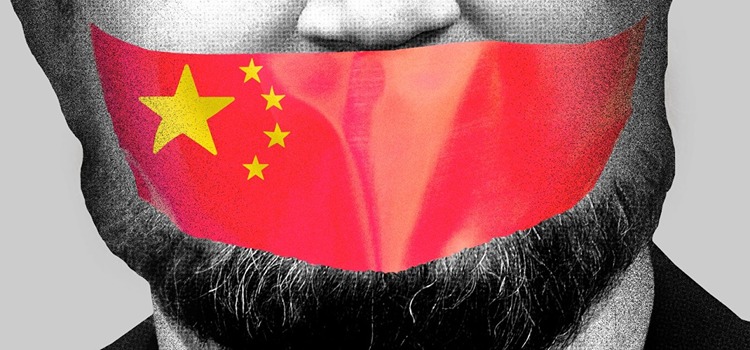
Contrary to common assumptions, censorship is not exclusive to authoritarian systems. Even democratic societies deploy mechanisms that limit or shape public discourse, whether through regulation, media concentration, public relations strategies or disinformation. However, in authoritarian contexts, censorship remains a core instrument of political control, directly aligned with the interests of those in power.
In April 2021, China’s Cyberspace Administration (CAC) launched a public reporting hotline encouraging internet users to denounce online comments deemed “illegal” or accused of “distorting” the historical achievements of the Chinese Communist Party or attacking the country’s leadership. The initiative was presented as a measure to protect social stability and historical accuracy. In practice, it marked another step in the tightening of ideological and informational control.
Notably, one of the first figures affected by this mechanism was former Chinese Premier Wen Jiabao. An essay written by Wen in memory of his late mother was published in the Macau Herald, a small weekly newspaper. In the piece, Wen described his mother’s experiences as a schoolteacher persecuted during periods of political upheaval in China, including the Sino-Japanese War and the Cultural Revolution. He recounted episodes of house arrest, interrogation and physical abuse — descriptions that touched on chapters of history the Party has long sought to carefully manage.
Towards the end of the essay, Wen outlined his vision of an ideal China, one characterised by fairness, justice, respect for human dignity and freedom. Although the text made no explicit reference to current political leadership, many readers interpreted it as an implicit critique of contemporary governance, particularly under President Xi Jinping.
The response was swift. Attempts to share the article on WeChat triggered warnings that the content violated platform regulations. On Weibo, references to the essay were limited, comments were disabled and links to related articles returned “404” error messages, indicating removal. Neither platform offered public explanations, but the pattern aligned closely with established censorship practices.
Wen Jiabao, who served as prime minister from 2003 to 2013, has long been regarded as one of the more reform-minded figures within China’s senior leadership. Earlier in his career, he worked closely with Zhao Ziyang, the former Communist Party General Secretary purged after opposing the violent suppression of the 1989 Tiananmen Square protests. Wen himself has previously been censored, notably after stating in a 2010 interview with CNN that freedom of expression was “indispensable” and that the Chinese people’s aspirations for democracy were “irresistible” — remarks that were quickly removed from China’s internet.
Compared to those earlier statements, the 2021 essay was measured and restrained. Yet the political environment had changed significantly. Under Xi Jinping, tolerance for ambiguity, historical reflection or implicit critique has narrowed considerably. Even symbolic references to freedom or justice now carry political weight.
For observers, institutions and companies operating in or engaging with China, this episode served as a clear signal. Control over information, historical narrative and public discourse is no longer confined to activists or dissidents; it extends to former state leaders and respected figures within the system itself. The boundaries of permissible expression have become increasingly rigid and unpredictable.
As China continues to strengthen its regulatory and ideological frameworks, understanding these dynamics is essential. They shape not only the media landscape, but also the broader operating environment for foreign businesses, institutions and stakeholders navigating the country’s political and digital ecosystem.