
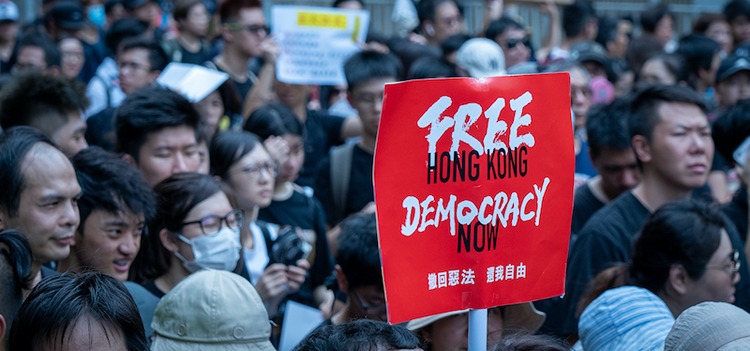
For weeks now I have been reporting on what has happened — and continues to happen — in Hong Kong through the pages of El Punt Avui. As one might expect, space in a daily newspaper is limited, and many other events unfolding in Europe and around the world also demand attention. For that reason, I would like to use this space — my personal blog — to go further and share a broader analysis of what is taking place in the former British colony.
Last week, Hong Kong effectively dissolved its own autonomy — the very feature that had made it one of the most dynamic and attractive economic and business hubs on the planet. At 11:00 p.m. local time on June 30, the National Security Law imposed by the Standing Committee of China’s National People’s Congress came into force, with the enthusiastic consent of the local government — an act that amounts to political suicide for Hong Kong’s own administration.
For the United Kingdom, this represents a blatant and shameless violation of the 1984 Sino-British Joint Declaration, signed by Chinese Premier Zhao Ziyang and British Prime Minister Margaret Thatcher. That agreement guaranteed Hong Kong’s autonomy under the “one country, two systems” framework for at least fifty years after the handover — until 2047.
Inserted into Annex III of the Basic Law (Hong Kong’s mini-constitution), the National Security Law has led to the establishment of the Office for Safeguarding National Security in Hong Kong. The office is headed by Zheng Yanxong, a loyal Beijing hardliner who previously served as Communist Party secretary-general of Guangdong province and earlier as its deputy propaganda chief.
Zheng will not be operating alone. Beijing has flooded the office with agents directly supervised by the central government, whose primary mission is to extend Beijing’s control and influence into every corner of the city.
Formally, the institution is overseen by the Committee for Safeguarding National Security of the Hong Kong Special Administrative Region, chaired by Chief Executive Carrie Lam. In practice, however, the committee includes a national security adviser appointed directly by the Central People’s Government, ensuring Beijing’s direct intervention in Hong Kong’s internal affairs.
According to the committee’s own framework, all levels of the legal system — from the police and prosecutors to the courts — will include national security “specialists,” many of whom will not be from Hong Kong. The national security department within the Hong Kong police will be allowed to recruit “specialists and technicians” from outside the city, opening the door for mainland Chinese security forces to operate openly and replicate China’s internal security apparatus in Hong Kong.
Under the pretext of protecting national secrets and public order, national security cases may be tried behind closed doors and without a jury. It is difficult to imagine that this development has been well received in London.
It is increasingly clear that this new legal and institutional framework is only the beginning. The National Security Office led by Zheng and his agents will, in practice, become the supreme authority in the Hong Kong Special Administrative Region. The appointment of Luo Huining — director of Beijing’s Liaison Office in Hong Kong — as national security adviser to the committee further confirms the arrival of a de facto mini–State Security Ministry in the city, firmly under Beijing’s control.
The office will not only dictate the pace of Hong Kong’s government but will also exercise direct jurisdiction over major national security cases. Suspects may be extradited to mainland China; state prosecutors will handle cases directly; and China’s Supreme People’s Court will designate the courts that hear them. Crucially, personnel from the national security office will not be subject to Hong Kong’s jurisdiction while carrying out their duties.
In this way, Beijing has effectively imposed extradition to mainland China by force, violating all previous legal safeguards.
Over the past years of protests, pro-democracy groups — and, according to recent polls, a majority of Hong Kong citizens — have called on the United States to impose sanctions on Hong Kong, fully aware that such measures would likely mark the end of the city as an international financial hub. Beijing, however, is not standing idle. Anticipating this scenario, it has orchestrated the future arrival of major Chinese corporations, including Alibaba, with planned investments exceeding 20 billion US dollars.
Nevertheless, the enactment of the National Security Law has severely shaken confidence in the city. The international community’s response has largely focused on offering escape routes to Hong Kong citizens — first the United Kingdom, followed by Taiwan, Australia and others.
Hong Kong will likely never be what it once was. Several cities are already positioning themselves to replace the unique role the former colony played in the global economic landscape. Yet events are still unfolding, and the people of Hong Kong may not have spoken their final word. Resistance to these aggressive moves by Beijing may simply be a matter of time.