
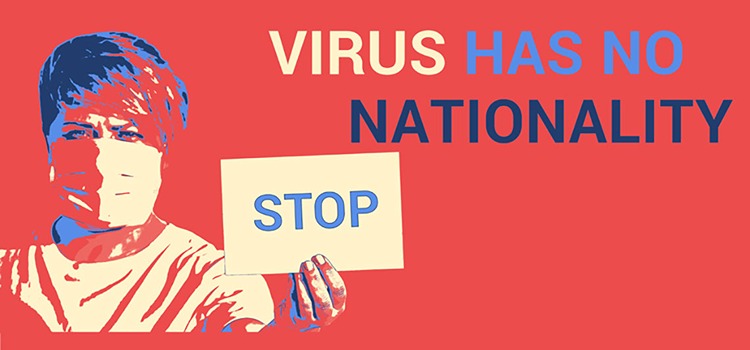
In the early days of the coronavirus outbreak, openly racist attitudes towards people of Asian appearance became increasingly visible across Europe, as well as in the United States and other English-speaking countries. Newspapers, radio stations and television networks documented numerous incidents throughout late January and early February: harassment, discrimination and, in some cases, physical assaults. These episodes, widely reported at the time, exposed a troubling social undercurrent that resurfaced with alarming speed.
Yet, unfortunately, the coronavirus did not create this phenomenon. It merely reactivated it. Racism in Western societies is deeply rooted, shaped over centuries — from medieval prejudices to the rise of so-called “scientific” and cultural racism in nineteenth-century Europe, and later adapted to modern political and social contexts. What the pandemic revealed was not a new form of intolerance, but rather the persistence of an old one.
China’s consolidation as the world’s second economic, commercial and military power, combined with the arrival over the past two decades of a small but well-organized wave of Asian migrants to Western Europe, has contributed to the reawakening of a familiar and uncomfortable narrative. Over the years, I have personally witnessed numerous expressions of this racism across Europe, including in our own societies, affecting friends, partners of friends and acquaintances who have been subjected to xenophobia and exclusion.
A limited and stereotyped perception of Asian communities often leads to reductive and unilateral constructions of entire groups. These simplifications do not merely hinder social integration; they weaponize prejudice. Assumptions about work ethic, dietary habits, social behavior or even sexual characteristics are among the most recurrent stereotypes — clichés that many people have encountered, knowingly or not, at least once.
Even in professional environments, subtle forms of distrust or bias towards Asia persist. Without naming specific cases — as everyone is entitled to their own beliefs — it is evident that eurocentrism, as a variant of ethnocentric worldview, remains deeply ingrained across social strata, from intellectual elites to those with limited formal education. The world, however, looks very different when observed from outside Europe, and from that broader perspective, Europe does not always appear as open-minded or self-aware as it often claims to be.